By Rachel Urbas | Certified Psychological Health and Safety Instructor & Consultant
Mention the National Standard of Canada for Psychological Health and Safety in the Workplace (CAN/CSA-Z1003-13) to an HR professional or safety manager, and you will often hear a deep sigh.
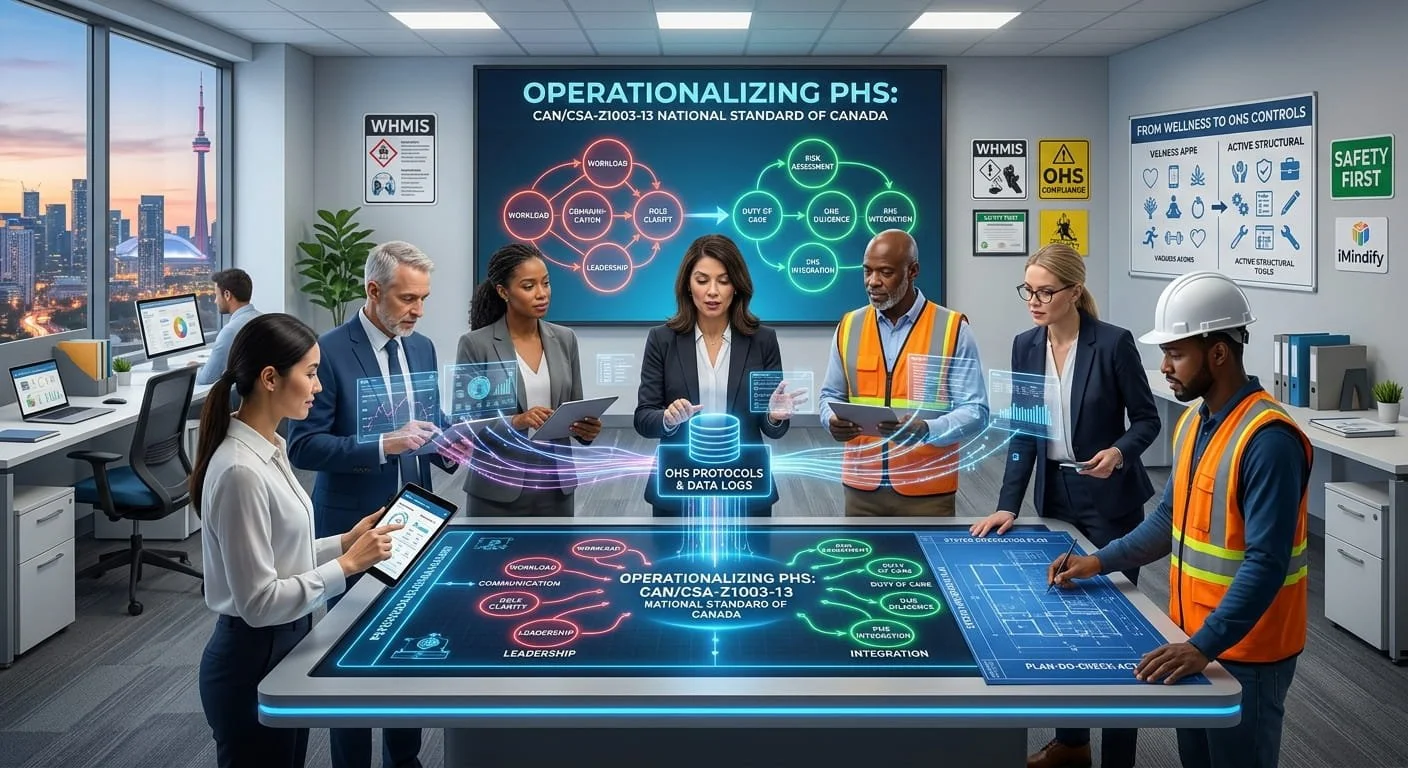
The overwhelming perception is that implementing a Psychologically Healthy and Safe (PHS) system requires a massive, multi-year structural overhaul, a dedicated six-figure budget, and hundreds of hours of administrative friction.
While full implementation is a thorough process, getting started does not need to be complicated.
Workplaces get paralyzed trying to build a perfect system from scratch. In reality, the foundation for Psychological Health and Safety is already sitting on your desk.
The secret is knowing how to operationalize what you already have and shifting your mindset from "wellness perks" to Occupational Health and Safety (OHS) compliance.
1. You Already Have PHS (You Just Haven't Operationalized It Yet)
📌 KEY DEFINITION: What is a Psychosocial Hazard?
A psychosocial hazard is any workplace factor—such as excessive workload demands, lack of role clarity, poor leadership communication, unmanaged conflict, or organizational friction—that increases the risk of psychological or physical harm to an employee.
If your organization complies with Canadian Employment Standards, Occupational Health and Safety Acts, and Human Rights legislation, you already have a PHS foundation.
Legally, employers have a non-negotiable Duty of Care to protect workers from foreseeable workplace harm. Courts, Workers' Compensation Boards (WSIB/WCB), and Human Rights Tribunals no longer differentiate between a physical injury (like falling off a ladder) and a psychological injury (like traumatic mental stress caused by unaddressed workplace hazards).
Where workplaces get confused is operationalizing these legal duties.
Having a written policy that says "We treat everyone with respect" does not prove due diligence. To demonstrate due diligence, an workplace must show that it actively identifies, assesses, and controls invisible, nuanced psychosocial hazards before they cause psychological harm.
REGULATORY STANDARD: What is CAN/CSA-Z1003-13?
CAN/CSA-Z1003-13 is the National Standard of Canada for Psychological Health and Safety in the Workplace. Developed by CSA Group and the Mental Health Commission of Canada (MHCC), it provides a voluntary framework for employers to systematically identify, assess, and control psychosocial hazards across 13 core organizational factors.
2. PHS is an OHS Control—Not a Wellness Initiative
One of the biggest corporate missteps is misclassifying Psychological Health and Safety as a "Wellness Initiative."
A meditation app will not protect an employee from a toxic reporting line or a broken accommodation process. PHS is about identifying and controlling invisible, nuanced workplace hazards that employers are legally obligated to manage.
| Voluntary Wellness Perks | PHS OHS Controls |
|---|---|
| • Focuses on individual employee resilience | • Eliminates systemic organizational risk |
| • "Nice-to-have" voluntary participation | • Non-negotiable legal duty of care |
| • Fails to fix structural workplace hazards | • Directly controls & mitigates workplace hazards |
The Operational Trap: Even Gold-Standard Training Can Fail
Even world-class training programs like Mental Health First Aid (MHFA) and The Working Mind (TWM) can fail to function as true Administrative Controls if they are treated as isolated events. MHFA and TWM are designed to mitigate psychological harm that cannot be fully engineered out of the workplace.
However, if these programs are not embedded into a continuous Plan-Do-Check-Act (PDCA) management cycle, they default right back to being "wellness initiatives."
Unless training is backed by operational policies, continuous risk assessments, leadership accountability, and regular reviews, it remains a superficial patch rather than a functional safety control.
The 3 Litmus Tests: Is Your Workplace Doing PHS or Just Wellness?
To determine whether your organization is running a true OHS risk-management protocol or simply running a wellness campaign, ask these three diagnostic questions:
1. Is participation voluntary?
If completing baseline psychological health training or adhering to mental health safety protocols is optional, it is a wellness initiative, not PHS.
Safety protocols are never optional. Just as physical safety orientation or WHMIS compliance is mandatory for all personnel, foundational PHS literacy must be integrated into core operational requirements.
2. Are you actively evaluating the outcomes?
If your organization tracks course completion rates but doesn’t evaluate changes in incident reports, accommodation requests, manager check-in frequency, or psychological safety metrics, it is a wellness initiative, not PHS.
An OHS control requires measurement: you must audit whether the hazard was actually mitigated and check if the training altered operational behaviour.
3. Is the program powered by a single passionate manager?
If your mental health effort relies on one champion pushing for change, ask yourself: What happens to the program if that manager leaves tomorrow? Does the entire system collapse?
If the answer is yes, it is a personal passion project—a wellness initiative—not an organizational PHS system.
True OHS protocols are institutionalized into job descriptions, onboarding pipelines, standard operating procedures, and management KPIs so they survive leadership turnover.
3. PHS is the New WHMIS (And Everyone Needs the Basics)
A common mistake organizations make is training only a select few, like HR or a couple of senior executives, and assuming PHS is covered.
Think of PHS training the same way you think of WHMIS (Workplace Hazardous Materials Information System). You wouldn't train just one manager on chemical safety and leave the rest of the workforce in the dark.
Every single employee needs an Introduction to PHS so they can recognize psychosocial hazards, understand their rights, and use a common language to report risk.
However, PHS starts with leadership understanding what it is and how to operationalize it first before rolling it out across the workforce.
A successful system relies on a diverse, cross-functional PHS Implementation Team that represents different perspectives across the organization:
👥 Ideal PHS Implementation Team Structure
- • Senior Leadership Sponsorship & Resource Allocation
- • HR & OHS Representatives Policy Alignment & Due Diligence
- • Joint Health & Safety Committee Hazard Identification & Compliance Oversight
- • Middle Managers & Team Leads Cross-Departmental Operational Reality
- • Frontline Staff Ground-Level Hazard Insights
Different roles experience different hazards. A middle manager faces psychosocial hazards like constant role conflict and moral distress; a frontline worker faces hazards like physical burnout or high job demands. Every position plays a unique role in maintaining the system.
4. The Real Budget Isn't Money—It's Time
Workplaces delay PHS adoption because they assume it requires a massive financial budget. While resources are necessary, the true currency of PHS is time.
If PHS tasks are dumped on employees as an "extra duty" to handle when they have free time, you are actively creating a psychosocial hazard.
Expecting staff to absorb PHS responsibilities on top of 100% capacity triggers role ambiguity, schedule collapse, and undue stress, the exact factors defined by the National Standard as psychological risks.
PHS cannot sit on the side of a desk. It must be explicitly structured into position descriptions, workload allocations, and meeting schedules.
5. Low-Hanging Fruit: Add a PHS Lens to Existing Operations
You don't need new software or expensive consultants to begin. Start with what you already have and apply a PHS-informed lens to everyday workflows:
Incident Reports: Add a simple check-box or field to record psychological hazards or near-misses (e.g., verbal aggression, extreme workload spikes, traumatic incidents) alongside physical injury tracking.
Grievance & Accommodation Logs: Audit existing grievance data to spot underlying psychosocial trends. Are certain departments seeing repeated accommodation requests tied to burnout or communication breakdowns?
Regular Check-Ins: Teach managers to ask simple, structured check-in questions during routine 1-on-1s to gauge how workers perceive workplace PHS in real-time.
6. Audit Your Policies: "If a Person Has to Ask, There Might Be a Problem"
Take a hard look at your workplace policies and procedures. Are they buried in a massive 300-page PDF or a dusty physical binder? If so, your policies themselves are creating a psychosocial hazard.
Policies and procedures are naturally unaccommodating when they force employees to hunt through dense legal jargon just to find out how to request help, report harassment, or access accommodations.
At iMindify, we use a simple rule of thumb: "If a person has to ask, there might be a problem."
If an employee has to ask who to contact, how to file a request, when a response will come, or where to get support, it reveals a breakdown in workplace communication. The friction, anxiety, and uncertainty of navigating a confusing policy is an invisible hazard in itself.
How to Fix It:
Digitize and Simplify: Move policies to searchable, digital formats where employees can easily mark confusing jargon, flag outdated protocols, or note where a policy fails in practice versus on paper.
Prioritize Accessibility: No one wants to scroll through thousands of pages of legalese. Disseminate critical procedures in bite-sized, accessible, and tolerable formats (visual flowcharts, quick-reference guides, clear contact paths).
Test Operational Reality: Ask your team: "Does this policy actually work in real life, or only on paper?"
Conclusion: Start Small, Operationalize Daily
By recognizing that your organization already possesses a baseline PHS foundation through existing OHS, Employment Standards, and Human Rights obligations, the work shifts from building something brand new to operationalizing the resources you already have.
Your immediate starting points:
Allocate Time, Not Just Money: Protect employee capacity so PHS duties do not become workload hazards.
Assemble a Cross-Functional Team: Bring together executives, HR, JHSC members, middle managers, and frontline staff.
Upgrade Existing Workflows: Add psychological risk fields directly into incident, grievance, and accommodation forms.
Streamline Policy Access: Eliminate administrative friction so staff never have to ask who, how, when, or where to get support.
Build Your Workplace PHS System with iMindify
At iMindify, we specialize in bridging the gap between legal duty of care and practical workplace execution. Whether you are seeking accredited Mental Health First Aid (MHFA) training, implementing The Working Mind (TWM), or operationalizing your CAN/CSA-Z1003-13 administrative controls, our team helps you create accessible, sustainable safety systems.
👉 Explore iMindify’s Workplace Training & PHS Facilitation Programs
Frequently Asked Questions About Implementing Psychological Health and Safety (PHS)
Is implementing the National Standard for Psychological Health and Safety mandatory in Canada?
While the CAN/CSA-Z1003-13 Standard itself is a voluntary framework, employers across Canada have a mandatory legal Duty of Care under federal and provincial Occupational Health and Safety (OHS) legislation to protect workers from foreseeable psychological harm. Integrating the Standard provides employers with the structured framework needed to demonstrate due diligence under OHS laws, Workers' Compensation legislation, and Human Rights codes.
How does Psychological Health and Safety differ from a corporate wellness program?
Corporate wellness programs (such as gym memberships, meditation apps, or yoga classes) are voluntary perks focused on individual employee resilience. In contrast, Psychological Health and Safety (PHS) is a systemic Occupational Health and Safety (OHS) control protocol. PHS focuses on identifying and controlling organizational hazards—like toxic management, workload imbalances, and unmanaged workplace conflict—that cause psychological harm in the first place.
Who should be on a workplace Psychological Health and Safety (PHS) committee?
An effective PHS implementation team should be cross-functional, representing all levels of the organization. Ideal team members include Senior Leadership (for sponsorship and resource allocation), HR and OHS representatives, Joint Health and Safety Committee (JHSC) members, Middle Managers, and Frontline Staff.
How can a workplace track psychological health hazards without high costs?
Employers can begin tracking psychological hazards by adding PHS-informed fields to existing operational tools. This includes adding psychological risk categories to physical injury incident reports, auditing grievance and accommodation logs for workload or conflict trends, and incorporating structured check-in questions into regular manager 1-on-1s.
What is the role of training programs like Mental Health First Aid (MHFA) and The Working Mind (TWM) in PHS?
Mental Health First Aid (MHFA) and The Working Mind (TWM) serve as Administrative Controls within an OHS hierarchy. They equip employees and leaders with the skills to recognize baseline shifts, de-escalate distress, and navigate accommodations. However, to function as true OHS controls rather than one-off wellness events, these training programs must be embedded into an ongoing Plan-Do-Check-Act (PDCA) management cycle.